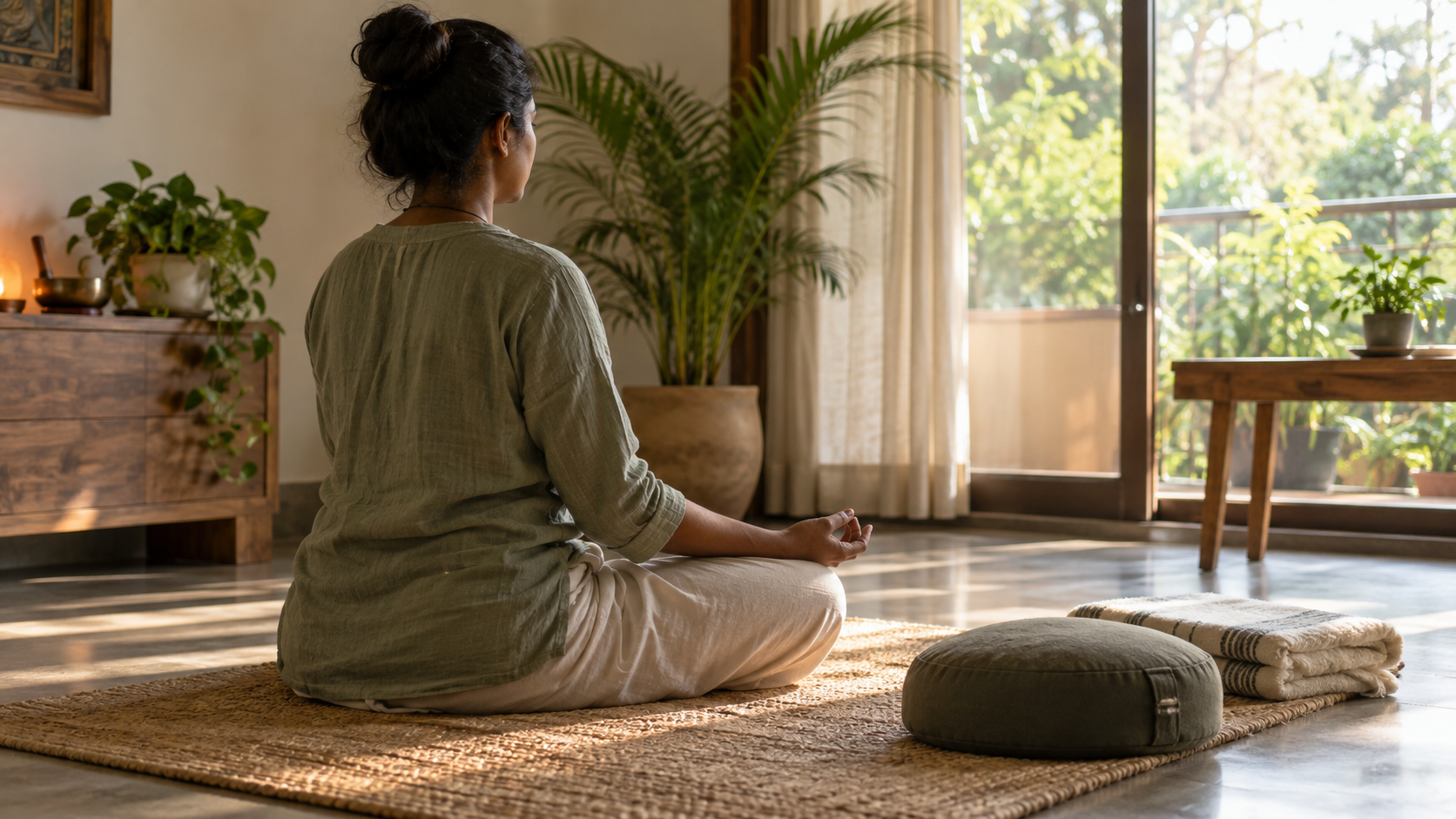
What the world's happiest country actually built
Coziness engineered as mental health infrastructure — not decor, and not an accident.
A feeling with no English name, because English never had to build one
Danes will tell you hygge cannot be translated. They are not being precious about it. They are telling you something true.
Hygge (pronounced roughly "hoo-gah") gets rendered into English as coziness, and the translation is not wrong so much as it is thin. Coziness describes a sensation — a blanket, a candle, a fireplace. Hygge describes a practice: the deliberate, repeated construction of an atmosphere in which people feel safe enough to fully exhale.
The conscious act of creating intimacy, warmth, and presence — usually with others, always without pretense. Not a mood that happens to you. A condition you build.
The root gives it away. Hugga meant to comfort, to console — the same root that gives English the word hug. Hygge was never about objects. It was about the nervous system. Long before anyone had language for cortisol or the vagus nerve, Scandinavians had a word for what happens in a body when it finally stops bracing.
Denmark keeps winning happiness rankings. That is not a coincidence you can shrug off.
Denmark has finished in the top three of the World Happiness Report in almost every edition since the ranking began, trading the top spot with its Nordic neighbors year after year. Researchers have spent over a decade trying to explain why — and the explanations that hold up all point past income and toward something more structural: how Danes actually spend their evenings.
The tempting explanation is wealth. Denmark is rich, taxes are high, the welfare state is generous. All true, and all insufficient. Countries with comparable GDP per capita routinely score lower on wellbeing. Something else is being measured in the happiness surveys — something closer to felt security than bank balance.
Hygge is a form of everyday togetherness, a practiced art of creating intimacy — a sense of belonging that comes from a mundane experience of being with other people. — Jeppe Trolle Linnet, anthropologist, on the sociology of hygge
What researchers keep landing on is this: hygge functions as a distributed social safety net for the nervous system. It is a shared, culturally reinforced habit of regularly and predictably lowering everyone's stress load together — at the exact moments (dark winters, long weeks, hard news) when stress tends to spike. Not therapy after the fact. Prevention, built into the calendar.
Built for the dark, on purpose
You cannot understand hygge without understanding Danish winter — seventeen hours of darkness a day, for months.
Denmark sits far enough north that December light disappears by mid-afternoon and does not return until well into the morning. Seasonal darkness at that scale is a documented driver of low mood, disrupted sleep, and seasonal affective patterns. A culture that ignored this would simply suffer through it. Denmark, instead, built a countermeasure and repeated it so consistently that it became identity.
Candlelight standing in for daylight. Small gatherings replacing the isolation that darkness invites. Heavy textiles, low warm lighting, unhurried meals — every element of hygge, examined closely, is a specific answer to a specific environmental threat. It is not aesthetic minimalism. It is applied psychology that predates the field of psychology, engineered by a population that had no other choice but to get good at surviving winter together.
Light as regulation, not ambiance
Danish homes burn more candles per capita than almost anywhere on earth — not for scent or style, but because warm, low, flickering light measurably lowers arousal compared to overhead lighting.
Small groups over big events
Hygge happens in twos, fours, sixes — never crowds. The intimacy is the mechanism. A room too large to hear everyone in it cannot hygge.
No hierarchy at the table
Danish social norms discourage boasting or status display — a cultural pattern Danes call janteloven. Hygge only works when no one in the room is performing for anyone else.
Regularity over spectacle
The power is not in one perfect evening. It is in doing an unremarkable version of it weekly, so the nervous system learns to expect relief on schedule.
What the rest of the world did to hygge
Around 2016, hygge left Denmark and became a global retail category — candles, blankets, knitwear, coffee-table books, an entire aisle of "hygge home" products. Sales followed. Something essential did not survive the trip.
The export kept the props and dropped the mechanism. Hygge was never the candle. It was the choice to sit near people you trust, without your phone, without an agenda, on a Tuesday, for no reason worth mentioning later. You cannot buy that at checkout. You can only schedule it.
| The Export | The Practice |
|---|---|
| Candles as decor | Light as a nervous-system cue |
| A cozy room, alone | A small room, together |
| An occasional treat | A weekly, unremarkable habit |
| Buying the aesthetic | Protecting the time |
Four things hygge is actually doing to a room
Strip away the aesthetics and hygge resolves into four repeatable, learnable moves.
Lower the light
Warm, dim, indirect light reduces physiological arousal compared to bright overhead lighting — the body reads it as evening, as safety, as time to stop performing.
Slow the pace
Nothing in hygge is rushed. A slow meal, a long conversation, unstructured time — the absence of urgency is itself the intervention.
Shrink the group
Presence is easier to sustain with fewer people. Hygge favors the kitchen table over the party — depth over scale.
Remove the audience
No performance, no phones, nothing being documented for later. Hygge cannot coexist with the feeling of being watched.
Add texture
Wool, wood, wax, warmth against skin — tactile softness is a cheap, reliable signal to the body that it is not on alert.
Repeat it weekly
A single cozy evening is a nice night. The same evening, most weeks, is infrastructure — a floor beneath the rest of your stress.
Building your own hygge, without moving to Copenhagen
You do not need a Danish winter to need this. You need a recurring appointment with warmth.
Pick one evening a week and protect it the way you would protect a meeting — same time, low ceremony, no cancelling for something merely urgent.
Turn off the overhead light. Lamps, candles, anything low and warm. The room should feel like it belongs to evening, not to an office.
Cap the guest list at four. Intimacy has a maximum room size before it becomes an event.
Put the phone in another room. Not on silent — away. Hygge cannot be interrupted without ending.
Choose something slow to eat or drink. Tea, a long dinner, bread that has to be torn. Slowness is the point, not a side effect.
Leave the agenda empty. No update to give, no plan to make. If it starts to feel productive, it has stopped being hygge.
Do it again next week — deliberately unremarkable, on schedule, whether or not the week earned it.
The infrastructure most people are missing
Modern life is well-supplied with stimulation and poorly supplied with recovery. Most wellness advice adds another task to an already full day — one more app, one more routine, one more thing to optimize. Hygge asks for the opposite: fewer inputs, smaller rooms, slower hours, on a schedule you can actually keep.
Denmark did not discover happiness. It discovered that comfort, taken seriously and repeated on purpose, behaves like infrastructure — something you build once and then simply maintain, rather than something you chase each time you run out of it.
The candle was never the point. The room built around it was.
Warmth, kept small and kept regular, is not a mood. It is something you can build — and something, once built, that holds you back.