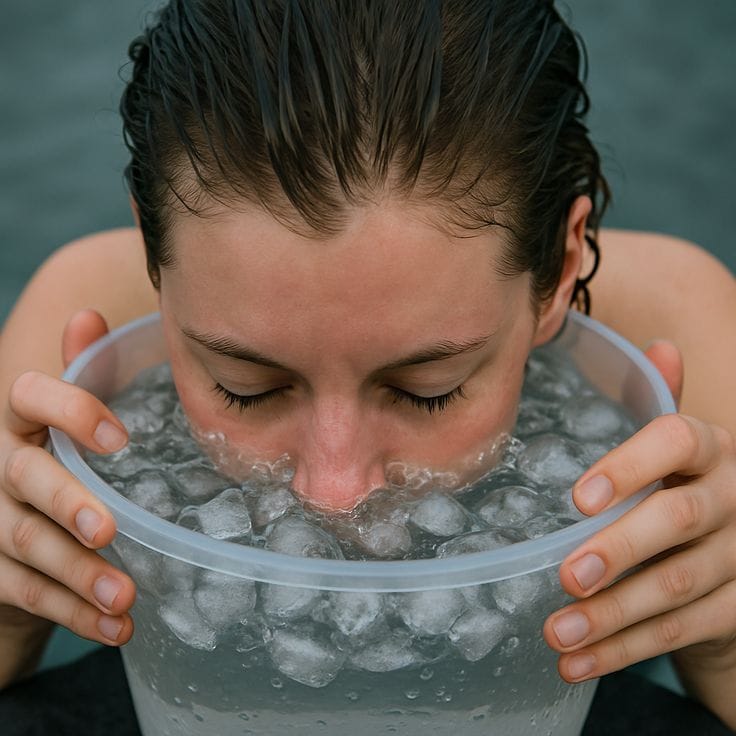
A Dutchman named Wim Hof once climbed partway up Mount Everest wearing nothing but shorts and boots. He has also run a full marathon above the Arctic Circle barefoot, sat in a tub of ice for nearly two hours, and let scientists inject him with a bacterial toxin that normally gives people fever, chills, and a pounding headache, just to see what would happen to a body trained the way his was. He barely reacted. That last part is the one worth paying attention to, because unlike the marathon and the mountain, it happened in a lab, with blood tests, and it is the single strongest piece of real evidence in an otherwise genuinely messy, overhyped, and under-examined corner of wellness culture: cold water immersion.
This is not going to be a cheerful list of cold plunge benefits, because half the claims circulating about ice baths do not survive contact with the actual research, and a few of them are quietly a little dangerous. Think of what follows as a case file. A claim gets made, the evidence gets checked, and a verdict gets reached, one at a time.
THE CLAIM: "It supercharges your immune system."
This is the one claim that actually has a real, peer-reviewed study behind it, and it is a genuinely strange one. In 2014, researchers at Radboud University in the Netherlands, led by Matthijs Kox, injected volunteers with a bacterial endotoxin, the kind that reliably produces flu-like symptoms in almost anyone. Half the volunteers had spent ten days learning Wim Hof's method: cold exposure, a specific hyperventilation-based breathing pattern, and meditation. The trained group produced more anti-inflammatory proteins, fewer inflammatory ones, and reported milder symptoms than the untrained control group. The study, published in the Proceedings of the National Academy of Sciences, was taken seriously precisely because it suggested something neuroscience had mostly assumed was impossible: that people could, with training, voluntarily influence their own autonomic nervous system and immune response.
The catch, and it is a real one, is that this was a small study, it combined cold exposure with specific breathing and meditation rather than testing cold alone, and "the immune system responded differently to an injected toxin in a lab" is a long way from "ice baths prevent your next cold." The marketing got there first. The evidence has not quite caught up.
Verdict: partially real, seriously overstated.
THE CLAIM: "It fixes your mood, maybe better than medication."
There is one genuinely interesting data point here, and it is a single patient, not a population. In 2018, a British anesthetist named Mark Harper published a case report in BMJ Case Reports describing a twenty-four-year-old woman with major depressive disorder who had declined medication. She began a program of weekly open water swims. Within weeks her symptoms had measurably improved enough that she stopped needing other treatment. It is a genuinely striking story. It is also one person, carefully documented, which is a world away from a clinical trial.
On the chemistry side, there is sturdier ground. A frequently cited study by Petr Šrámek and colleagues, published in 2000, found that cold water immersion triggered a roughly two-hundred-and-fifty percent increase in dopamine, alongside a smaller rise in noradrenaline, in healthy volunteers. That is a real, measurable neurochemical event, and it is plausibly connected to the mood lift so many cold plunge enthusiasts report immediately afterward.
Verdict: the chemistry is real and immediate. The idea that it treats clinical depression is, so far, one well-documented person, not a conclusion.
THE CLAIM: "It melts fat and revs up your metabolism."
This one leans on a genuine biological mechanism dressed up in considerably more confidence than the science currently supports. The Danish researcher Susanna Søberg has studied brown adipose tissue, a special type of fat that burns energy to generate heat, in regular winter swimmers, and found meaningful activation of it with consistent, repeated cold exposure over time. Brown fat activation is real. Whether an occasional three-minute cold plunge meaningfully changes anyone’s weight is a different question entirely, and the research gap between "this tissue exists and responds to cold" and "cold plunges burn fat" is exactly the gap most marketing copy quietly skips over.
Verdict: the mechanism is real. The size of the effect for an occasional plunge is nowhere near what gets claimed.
THE CLAIM: "Cold plunges after a workout speed up recovery."
This is the one place the evidence actively argues against the popular practice, rather than merely falling short of it. A study led by Jonathan Roberts, published in The Journal of Physiology in 2015, had young men do resistance training and then either cold water immersion or active recovery. Over twelve weeks, the group that did cold water immersion after lifting gained less muscle and strength than the group that didn't. The likely mechanism: the same inflammatory response that makes a muscle sore after training is also part of how it adapts and grows, and dousing it in cold water appears to blunt that signal along with the soreness.
Verdict: if the actual goal is building muscle, the research suggests this specific habit works against you, not for you.
THE RISK THE MARKETING LEAVES OUT
There is a physiological reflex called cold shock response, and it is not a minor inconvenience. Sudden immersion in cold water triggers an involuntary gasp, a spike in heart rate and blood pressure, and in people with underlying heart conditions, a real risk of cardiac events. Lifesaving organizations, including the RNLI in the United Kingdom, point to cold shock as a significant factor in open water drowning deaths, precisely because that first gasp can happen underwater or can be followed by hyperventilation strong enough to impair swimming. None of this means a cold plunge is dangerous for a healthy adult easing in gradually. It means the influencer version, jumping straight into a frozen lake for a dramatic video, is doing something closer to a controlled risk than a wellness routine, and the difference matters.
The Verdict
Strip away the marketing and what remains is a practice with one unusually strong, slightly narrow piece of immune and autonomic research behind it, a real and immediate dopamine spike, a plausible but thin thread of evidence on mood, a fat-burning mechanism that exists but is wildly oversold, and, buried under all the enthusiasm, a documented case where the common habit of plunging right after a workout actually undercuts the goal most people are plunging for in the first place. Cold water immersion is not nothing, and it is not nothing dangerous either. It is a genuinely interesting, moderately promising practice that got picked up by a marketing machine built for simpler, bigger claims than the actual research is prepared to make.
If You Are Going to Try It Anyway
- Ease in rather than jumping, to blunt the cold shock reflex rather than trigger it at full force.
- Skip it immediately after a strength session if muscle growth is actually the goal; a few hours apart avoids blunting the adaptation signal.
- Treat the mood lift as real but temporary chemistry, not a substitute for treatment of a real depressive episode.
- Never do it alone in open water, given how the research on cold shock and drowning risk actually reads.
- Expect a genuine wake-up jolt and a real, if modest, dopamine lift. Expect considerably less from it on the scale, and considerably less from it as immune insurance than the bottle of cold plunge merchandise implies.